
Tooth decay is one of the most common diseases worldwide, yet many misconceptions about it persist. Tooth decay is often only noticed when pain occurs, but it starts much earlier and can even be stopped in its early stages.
In this article, you'll learn:
- how tooth decay develops
- which stages of tooth decay there are
- whether and when tooth decay can be treated
- what really protects against tooth decay
- and when treatment is necessary
What is tooth decay?
Tooth decay is one of the most common dental diseases. The hard tissues of the teeth are attacked by acids produced by bacteria in the mouth. If left untreated, tooth decay can cause pain, inflammation and, in the worst case, tooth loss.
👉 Important to know:
Tooth decay develops graduallyover weeks, months or even years.
How does tooth decay develop? (a simple explanation)
Many bacteria live in the mouth, and most are harmless.
It becomes problematic when certain bacteria regularly consume sugar from food .
In simple terms, the process works like this:
- Sugary food sticks to the teeth
- Bacteria turn sugar into acids
- The acids attack the enamel
- Minerals are dissolved from the tooth (demineralisation).
- If this is not balanced out, tooth decay develops.
1. Dental plaque forms
After eating, food debris and bacteria accumulate on the teeth, forming a sticky film called plaque.
Plaque tends to build up in:
- spaces between the teeth
- pits and fissures (grooves on chewing surfaces)
- the gumline
If plaque is not removed regularly, large numbers of bacteria can multiply in it.
2. Bacteria turn sugar into acid
Certain bacteria use sugar from food as a source of energy. Acids are produced in the process.
These acids attack the tooth enamel.
The main culprits are:
- sweets
- soft drinks
- fruit juices
- frequent snacking
It is not the amount of sugar that matters most, but how often you consume it.
3. The enamel loses minerals
Acids gradually demineralise the tooth enamel, dissolving important minerals such as calcium and phosphate from the tooth.
At this stage, you may notice:
- white spots on the tooth
- increased sensitivity
- no pain yet
This early stage is often still reversible.
4. A cavity forms
If mineral loss continues, the enamel becomes porous and is eventually destroyed. A visible cavity forms in the tooth.
Tooth decay can now:
- cause pain
- reach the inner part of the tooth
- make root canal treatment necessary
Saliva, minerals and good oral hygiene can counteract this process – but only up to a point.
People who eat and drink a lot of sugary foods have a higher risk of tooth decay, because bacteria use the sugar as food and can therefore produce more acids.
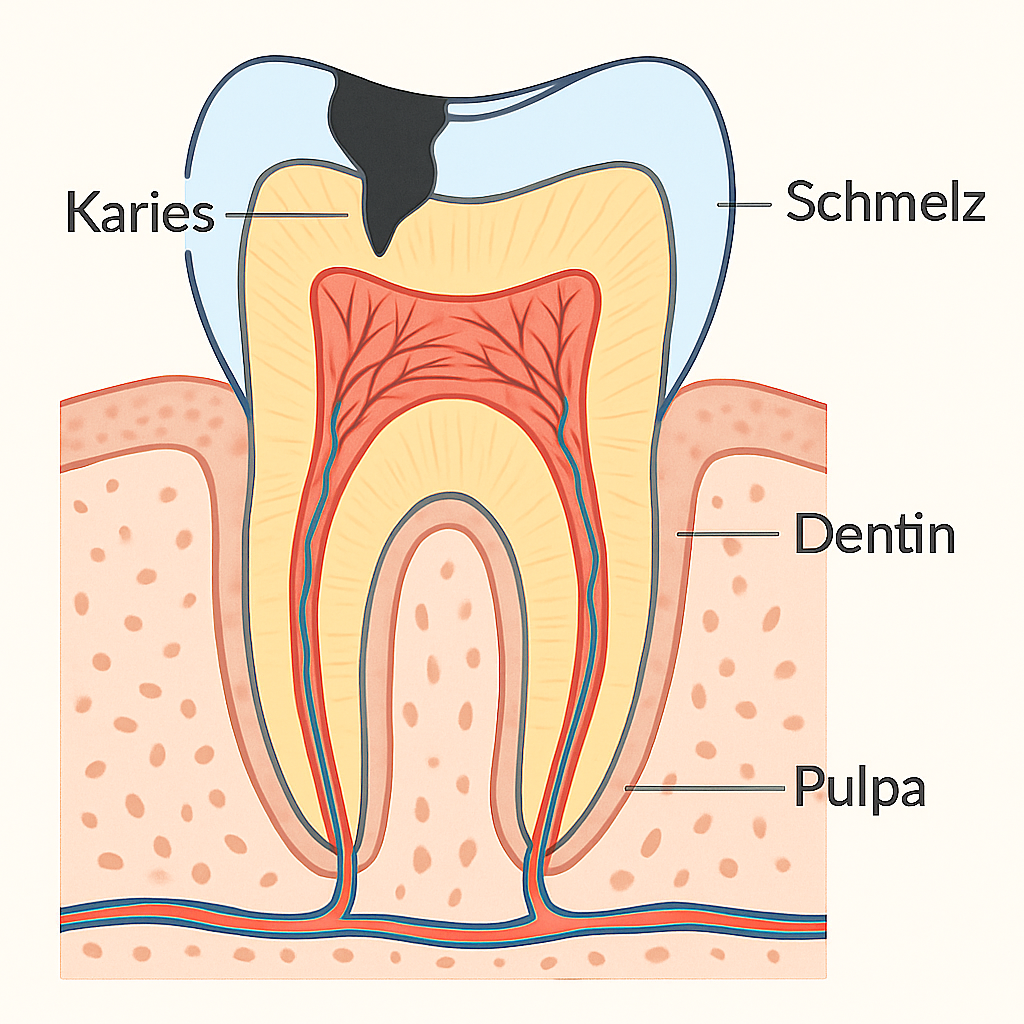
What are the stages of tooth decay?
1) Initial decay (early stage)
Where bacterial plaque starts to stick to the tooth, decay-causing bacteria begin turning simple sugars in food into lactic acid. Whitish areas of demineralisation form on the tooth surface. (white spots). Tooth enamel is made up of tightly packed crystals that lose volume when exposed to acid. As a result, the surface becomes milky and more porous, like scratched glass.
👉 Good news:
At this stage, tooth decay can be stopped or even reversed .
2) Enamel decay
If acid exposure continues, bacterial attack can progress deeper into the enamel along the crystal structure. The surface often remains intact at this stage, so few or no bacteria have yet penetrated into the tooth itself. Up to this point, good home oral care and dietary improvements can still halt the progression and, in some cases, even reverse it.
3) Dentin decay
At this stage, tooth decay has reached the inner hard tissue of the tooth. The surface is often damaged by softening, and bacteria begin to enter the tooth. Because dentine also contains proteins, bacteria can survive even when no sugar is available as a food source. At this point, further decay can only be prevented with treatment by a dentist.
4) Decay reaching the pulp
As the cavity grows, bacteria gradually make their way to the dental pulp (the tooth’s nerve). This network of nerves, blood vessels and connective tissue lies at the centre of the tooth and is highly sensitive to bacterial attack. This is usually the first stage at which pain occurs. If too many bacteria reach the pulp, root canal treatment is needed to remove the infection.
5) Advanced decay with inflammation at the root tip
The final stage involves extensive loss of hard tooth tissue. The pain often suddenly subsides. This is because the entire nerve and blood vessel bundle dies, so the tooth no longer produces nerve pain.
At this stage, the tooth can no longer be saved without root canal treatment to remove the infected tissue and bacteria, as the infection could otherwise spread through the root canals into the bone.
If too much tooth structure has been lost or the infection is too advanced, the tooth may need to be extracted in the worst case.
How can you recognise tooth decay?
Possible signs include:
- white or brown spots on the teeth
- sensitivity to sweet, cold or hot foods
- pain when chewing
- visible cavities
- bad breath
👉 Many people have no early symptoms – which is why regular dental check-ups are so important.
If decay has reached the dentine, dark cavities form and the tooth becomes painful. It may react to hot, cold and sweet foods. If decay reaches the dental pulp, it can cause severe, persistent pain. If this pain stops, it may be a sign that the dental pulp is permanently damaged .
Is tooth decay contagious?
The bacteria that cause tooth decay can be transmitted, for example through saliva.
Whether tooth decay actually develops depends largely on:
Tooth decay is therefore not typically a contagious diseasebut the result of several interacting factors.
Can tooth decay be reversed?
This is possible in the early stages.
If only demineralisation is present (a white spot), the enamel can recover.
This can be achieved through:
- good oral hygiene
- fluoride
- a low-sugar diet
- regular dental check-ups
Once a cavity has formed, tooth decay cannot reverse on its own.
Treatment is then necessary.
What increases the risk of tooth decay?
Several factors increase the risk of tooth decay. One of the most important is poor oral hygiene – for example, when the spaces between the teeth are not cleaned. This gives bacteria enough time to convert carbohydrates in food into acids, which strip minerals from the enamel and dissolve the hard tooth tissue.
Another risk factor is a diet high in sugar and carbohydrates. The more sugar and carbohydrates that decay-causing bacteria have available, the more harmful acids they can produce.
A low saliva flow also increases the risk of tooth decay. Saliva in the mouth neutralises acids and supplies the enamel with minerals. Saliva also washes bacteria off the tooth surface. If too little saliva is present, this protective function is lost.
Some people are also more prone to tooth decay than others. This is due to differences in the pH (acidity) of their saliva. The lower the pH, the more harmful acid attacks are to the teeth.
Tooth decay in children: why is it so common?
Children are at higher risk because:
- their tooth enamel is thinner
- their brushing technique is often not yet adequate
- they eat sweets more often
- their baby teeth are more sensitive
Especially problematic are:
- sugary drinks in a bottle
- constant sipping from a bottle
- lack of oral care
What protects against tooth decay?
The good news:
In most cases, tooth decay can be prevented.
The key measures
Teeth should be brushed at least twice a day – and properly!
Do not scrub aggressively; use gentle, circular motions instead.
Most importantly, brush for two minutes with fluoride toothpaste.
Use toothpaste with protective ingredients at least twice a day
- fluoride strengthens the enamel and makes it more resistant
- hydroxyapatite can fill small defects and smooth the surface
The best toothpaste for you depends on your individual risk of tooth decay.
Clean between your teeth
A toothbrush often cannot reach these areas.
Useful tools include:
- dental floss
- interdental brushes
Sugar? Yes, but with breaks.
The aim is not to ban sugar, but to consume it in fewer, more defined occasions.
It is better to have chocolate once after lunchthan to eat it throughout the day.
The key idea is a sugar break. Saliva needs time to repair the enamel.
The hidden danger: fruit juice and fruit pouches.
They may seem healthy, but they are highly acidic for baby teeth.
Water is the best drink for a child’s teeth. Full stop.
Nutrition: a toothbrush from within
Crunchy vegetables such as carrots or peppers act like a mini toothbrush.
Calcium-rich foods such as milk, cheese and yoghurt strengthen tooth enamel.
What you eat can later be seen in your mouth.
Reduce sugar
Particularly important:
- fewer sugary drinks
- regular meals instead of frequent snacking
- water as the standard drink
Make the dentist a friend, not a source of fear.
Early, positive dental visits help children overcome their fear.
Preventive care, check-ups and explanations tailored to children all help before drilling becomes necessary.
Can tooth decay be stopped or healed?
👉 Early stages, yes; advanced decay, no.
- Early decay can be stopped through remineralisation.
- Cavities that have already formed cannot close on their own.
That is why early action matters.
FAQ: Frequently asked questions about how tooth decay develops
How can tooth decay develop even if you brush your teeth?
This can happen when:
- you do not brush for long enough
- the spaces between your teeth are not cleaned
- you consume sugar too often
- your brushing technique is inadequate
Is tooth decay contagious?
Yes, the bacteria that cause tooth decay can be transmitted.
For example, through:
- sharing cutlery
- kissing
- licking a pacifier before giving it to a child
This is especially relevant for young children.
How long does it take for tooth decay to develop?
It varies.
Usually:
months to years
Under unfavourable conditions, tooth decay can develop much faster.
Can tooth decay develop without pain?
Yes.
Early tooth decay often causes no symptoms, which is why regular check-ups are important.
Does tooth decay always hurt?
No. Early stages are often painless.
Can tooth decay go away on its own?
No. Only very early tooth decay can be stopped; an actual cavity cannot.
Is tooth decay a sign of poor oral hygiene?
Not necessarily. Diet, saliva and genetic factors also play a role.
Does mouthwash help prevent tooth decay?
Mouthwash can help, but it does not replace mechanical cleaning.
Conclusion: Tooth decay can be prevented with knowledge and routine
Tooth decay develops gradually, but it is not inevitable.
Good oral hygiene, a balanced diet and regular check-ups can significantly reduce the risk.
The earlier tooth decay is detected, the easier and gentler the treatment.
Note
This article is for informational purposes and does not replace dental advice.
Last updated:
17.02.2026
Editorial / medical note:
The content is for informational purposes and does not replace medical advice.